New York Container Moving Specialists

Shipping Container Transportation in New York

Professional shipping container transportation for residential, commercial, construction, manufacturing, port, rail and industrial projects throughout New York.

Container Movers coordinates dependable shipping container transportation throughout New York for homeowners, contractors, manufacturers, warehouses, distribution centers, ports, rail terminals, agricultural operations and commercial facilities.

Whether you need to relocate a 20-foot storage container in Albany, transport a loaded 40-foot container in Buffalo, coordinate container drayage associated with the New York metropolitan port network, arrange an intermodal rail terminal pickup, or position a Conex box at a construction site or rural property, our logistics specialists help coordinate the carrier, equipment and transportation method best suited to the move.

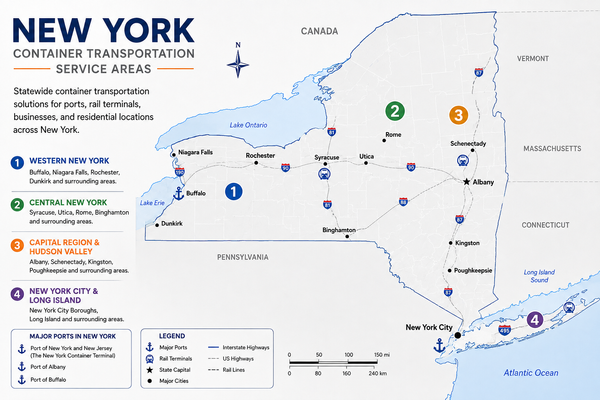
From New York City and Long Island to the Hudson Valley, Capital Region, Syracuse, Rochester, Buffalo and communities throughout Upstate New York, we help coordinate container transportation around New York's diverse freight corridors, site conditions and delivery requirements.

Loaded and Empty Containers 20 ft, 40 ft, 45 ft and High Cube Containers Port, Rail and Drayage Coordination Statewide and Nationwide Service

Industrial Moves

Loaded Containers

Port Pickups

Rail Transfers

Residential Delivery

Nationwide Service

Shipping Container Transportation Across New York

New York presents one of the most varied container transportation environments in the country. Downstate moves can originate around New York Harbor and move through densely developed metropolitan corridors, while Upstate projects may involve intermodal rail facilities, manufacturing centers, agricultural properties, Canadian trade routes or destinations hundreds of miles from the marine terminals.

The state’s principal east-west transportation spine follows the Hudson Valley to Albany and then the I-90/Mohawk-Erie corridor through Utica, Syracuse, Rochester and Buffalo. Northern routes connect the Capital Region with Montréal and other Canadian markets, while Western New York provides major freight connections through Buffalo and Niagara.

For container transportation, those differences matter. A marine-terminal pickup near New York City has very different scheduling and equipment requirements from a 40-foot container delivery to a Finger Lakes farm, an intermodal pickup in Syracuse or a ground-level placement at a commercial facility near Buffalo.

ChatGPT Image Aug 13, 2026, 01_48_15 PM.png

Ports: New York Harbor, Hudson River and Great Lakes freight gateways

Rail: CSX, Norfolk Southern, CPKC and statewide intermodal connections

Trade: Northeast distribution, Canadian trade and international freight corridors

New York's Freight System Is Supported By:

  • Port of New York and New Jersey
  • Port Liberty New York — Staten Island
  • Port of Albany–Rensselaer
  • Port of Oswego
  • Port of Buffalo
  • Port of Ogdensburg
  • Hudson River freight corridor
  • New York Harbor marine terminals
  • CSX Transportation
  • Norfolk Southern Railway
  • CPKC / Canadian Pacific connections
  • DeWitt Intermodal Terminal — Syracuse
  • Selkirk Yard
  • Interstate 87
  • Interstate 90
  • Interstate 81
  • Interstate 84
  • Interstate 86
  • Interstate 88
  • Interstate 95
  • New York–Canada trade corridors

NYSDOT's freight inventory specifically identifies DeWitt Yard in Syracuse as intermodal, Staten Island's container facility as intermodal, Port of Albany as rail-served, and numerous other transload facilities across the state. New York's international truck gateways include the Peace Bridge, Lewiston–Queenston Bridge and Champlain–Lacolle crossing.

Containers Are More Than Freight In New York

Shipping containers are used throughout New York for far more than international freight. Their strength, security and versatility make them practical for commercial operations, construction projects, manufacturing facilities, farms, municipalities and residential properties across the state.

Commercial Uses

Construction storage, jobsite offices, warehouse overflow, retail inventory, equipment storage, municipal operations, distribution staging and temporary commercial space.

Manufacturing & Logistics

Production equipment, machinery, components, raw materials, warehouse inventory, intermodal transfers, distribution staging and supply-chain support.

Residential & Agricultural Uses

Farm equipment storage, vineyard and orchard supplies, workshops, renovation storage, garage alternatives, seasonal equipment and rural property improvements.

Because many containers become long-term assets at their destinations, successful transportation requires planning not only how the container will travel, but how it will be unloaded and positioned once it arrives.

What New York Companies and Property Owners Look For

New York customers face transportation conditions that can change dramatically within a single move. A container leaving a marine terminal in the New York metropolitan area may encounter terminal procedures and dense highway traffic before traveling through the Hudson Valley, while an Upstate move may involve an intermodal yard, rural road, snowbelt community, manufacturing plant or agricultural property.

Customers therefore need transportation planned around the entire move rather than simply the mileage between pickup and delivery.

Port & Terminal Experience

Marine-terminal and intermodal moves can involve release requirements, appointments, chassis availability and specific pickup procedures. Drayage must be coordinated with the container's availability and the next stage of transportation rather than treated as an isolated truck move.

Equipment Matched To The Destination

A chassis may be appropriate for terminal-to-terminal movement but not for a customer who needs the container placed directly on the ground. Sideloaders, Landoll trailers, tilt-bed equipment and crane-assisted configurations provide different placement capabilities.

Loaded Container Capability

New York manufacturers, contractors and distributors frequently need containers moved with machinery, materials or inventory inside. Total loaded weight affects equipment selection, legal transportation requirements and site access.

Metropolitan Access Planning

Container transportation in New York City, Long Island and surrounding downstate communities can involve restricted truck routes, tight streets, limited staging areas and constrained delivery sites. The equipment appropriate for an open industrial yard may be impractical at a dense urban location.

Upstate Site Evaluation

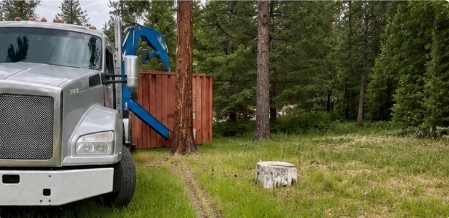
Outside the metropolitan region, the challenge often shifts from congestion to terrain and access. Farms, construction sites, mountain properties and rural destinations may have gravel roads, grades, low branches, soft ground or limited turning room.

One Coordinated Move

Container Movers helps coordinate pickup, drayage, highway transportation, unloading and final placement around the requirements of the specific project.

Ready to Move Your Shipping Container?

Whether you are transporting a 20 ft Conex box, a loaded 40 ft shipping container, an office container, a modified unit or multiple containers between New York facilities, Container Movers can help coordinate the appropriate equipment and carrier for your project.

Common Container Moving Challenges In New York

New York's geography creates unusually different transportation conditions between regions. Container moves can involve marine terminals at the southern end of the state, Canadian border crossings in the north and west, major Upstate rail facilities, mountain terrain, dense metropolitan neighborhoods and some of the nation's most challenging winter-weather corridors.

Commercial and Freight Challenges

New York Harbor Drayage: Container transportation associated with the New York metropolitan port system requires careful coordination between marine-terminal availability and inland trucking. Terminal releases, appointments, chassis arrangements and delivery schedules can determine when a container can actually leave the port environment.

Upstate Intermodal Transfers: New York's freight system includes major inland rail facilities, including DeWitt Yard in Syracuse. NYSDOT identifies DeWitt as an intermodal facility, making Central New York an important connection between rail transportation and final truck delivery.

The I-90 / Mohawk-Erie Freight Corridor: The east-west corridor through Albany, Utica, Syracuse, Rochester and Buffalo connects several of New York's largest commercial markets. NYSDOT describes the broader Mohawk-Erie corridor as a roughly 400-mile multimodal corridor connecting major centers of commerce across the state.

Canadian Trade: Western and Northern New York are directly connected with Canadian freight markets. Commercial crossings at Buffalo/Niagara and Champlain make international freight an important part of the state's transportation network.

Downstate Congestion & Space: New York City and its surrounding markets can provide very little room for large transportation equipment. Delivery windows, truck routing, traffic, parked vehicles and limited maneuvering space may all influence whether a particular unloading method is practical.

Site, Weather, and Residential Challenges

Lake-Effect Snow: Western New York communities east of Lakes Erie and Ontario can experience significant lake-effect snow. Weather can affect highway conditions as well as whether a residential, commercial or rural delivery site is accessible to heavy equipment.

Adirondack & Catskill Terrain: Mountain destinations can involve grades, winding roads, wooded access and limited turning space. These conditions make site evaluation particularly important before sending a long trailer or specialized container-handling equipment.

Long Island Access: Long Island container moves are geographically constrained by their relationship to the New York City transportation network. Route selection, congestion and the characteristics of the final property can become as important as distance.

Spring Ground Conditions: Snowmelt and seasonal rain can soften farm lanes, gravel drives and construction entrances. A site capable of supporting a container may not necessarily support the truck and trailer carrying it.

Early planning helps determine whether the intended route, equipment and final placement method are compatible before the carrier is dispatched.

Specialized Equipment For New York Container Moves

Selecting the proper transportation equipment can significantly improve efficiency, reduce handling and help ensure safe container placement. The right equipment depends on container size, loaded weight, access conditions and final placement requirements.

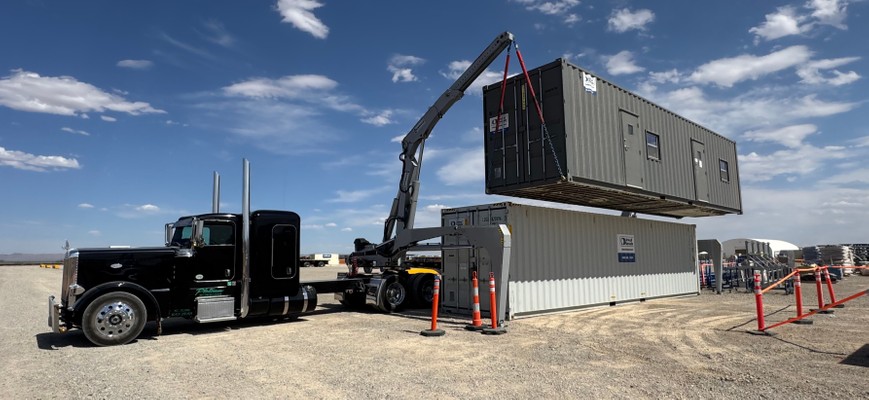
Container Movers Sideloader Truck with office container.jpeg

What Is a Sideloader?

A sideloader is specialized container-handling equipment capable of lifting, transporting and placing shipping containers directly from the side of the trailer. This equipment is ideal when ground-level placement is required or when a separate crane is not practical.

  • Ground-level loading and unloading
  • Reduced equipment coordination
  • Faster delivery scheduling
  • Precise placement capabilities
  • Suitable for many loaded containers
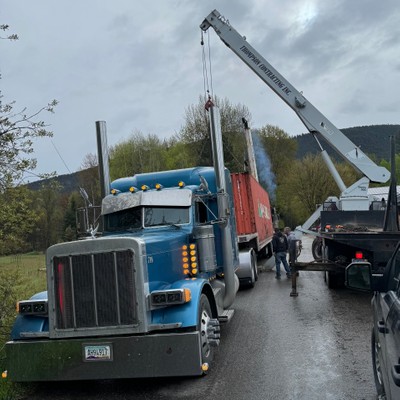
crane moving container from blue truck and trailer

What Is a Trailer-Mounted Crane?

Trailer-mounted cranes combine transportation and lifting capability into one piece of equipment, making them well suited for locations where containers must be placed beyond the immediate side of the trailer.

These systems are commonly used for commercial developments, industrial facilities, waterfront properties and construction projects with limited access.

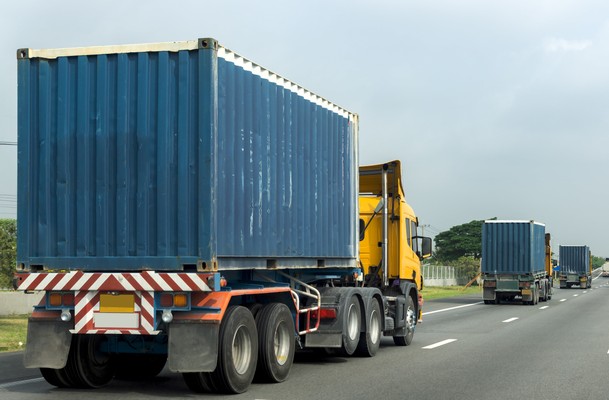
blue shipping containers being transported along highway

What Is a Container Chassis?

Container chassis are specialized trailers designed to transport ISO shipping containers between ports, rail terminals, warehouses, manufacturing facilities and commercial properties.

Because chassis are intended for transportation rather than unloading, additional equipment such as cranes, forklifts or sideloaders may be required at the destination depending on the project.

Container Transport Equipment Comparison: Landoll vs Crane vs Sideloader

Compare the best container transport options based on access, lifting capability, delivery environment, and overall efficiency.

Feature / Requirement Landoll Service Crane Service Sidelifter / Sideloader
Best For Short-distance relocations Long-distance hauling requiring lift support Self-loading in tight areas
Can Lift Container Off Ground? Yes (tilted winch) Yes Yes
Requires Additional Equipment Onsite? No Yes (crane required) No
Handles Loaded Containers? Yes (must secure load before tilt) Yes Yes
Ideal For Residential Delivery? Yes Rarely Yes
Best For Long Distance Transport? Short to Mid Yes Moderate
Works In Tight Access Areas? Requires clearance for tilt Requires crane access Excellent
Placement Precision Moderate Very High High
Cost Range Cost-efficient Higher Moderate to High
Setup Time Low Higher (rigging + crane setup) Low
Landoll Service
Best ForShort-distance relocations
Can Lift Container Off Ground?Yes (tilted winch)
Requires Additional Equipment Onsite?No
Handles Loaded Containers?Yes (must secure load before tilt)
Ideal For Residential Delivery?Yes
Best For Long Distance Transport?Short to Mid
Works In Tight Access Areas?Requires clearance for tilt
Placement PrecisionModerate
Cost RangeCost-efficient
Setup TimeLow
Crane Service
Best ForLong-distance hauling requiring lift support
Can Lift Container Off Ground?Yes
Requires Additional Equipment Onsite?Yes (crane required)
Handles Loaded Containers?Yes
Ideal For Residential Delivery?Rarely
Best For Long Distance Transport?Yes
Works In Tight Access Areas?Requires crane access
Placement PrecisionVery High
Cost RangeHigher
Setup TimeHigher (rigging + crane setup)
Sidelifter / Sideloader
Best ForSelf-loading in tight areas
Can Lift Container Off Ground?Yes
Requires Additional Equipment Onsite?No
Handles Loaded Containers?Yes
Ideal For Residential Delivery?Yes
Best For Long Distance Transport?Moderate
Works In Tight Access Areas?Excellent
Placement PrecisionHigh
Cost RangeModerate to High
Setup TimeLow

Can Containers Be Moved Without a Crane?

Yes. Many container transportation projects can be completed using sideloaders, eliminating the need for separate crane mobilization and reducing overall project costs.

Residential Delivery Equipment

Residential container deliveries often require sideloaders, trailer-mounted cranes, container chassis, and site access planning.

Prepare Your Site for Safe Container Placement or Delivery

Successful container transportation depends on more than selecting the right trailer or lifting equipment. The delivery site must provide adequate access, stable ground, sufficient clearance, and a properly prepared placement area.

Before dispatch, Container Movers may confirm site conditions such as slope, soil stability, overhead obstructions, gate width, turning space, and the intended placement location. Preparing these details in advance helps prevent delivery delays, additional charges, equipment damage, and unsafe placement conditions.

Container delivery truck moving through a wooded site with limited access

1. Ground Conditions

Containers should be placed on a firm, level, and well-drained surface. Suitable foundations may include:

  • Compacted gravel
  • Concrete pads
  • Railroad ties
  • Structural footings
  • Engineered container supports

Soft soil, mud, loose gravel, or uneven terrain can cause the container to settle, twist, or become misaligned. Poor ground conditions may also prevent safe access or completion of the delivery.

2. Access and Clearance

The delivery route must provide enough room for the truck, trailer, or sidelifter to enter, maneuver, unload, and exit safely.

Customers should confirm:

  • Gate and driveway width
  • Turning radius
  • Overhead wires and tree limbs
  • Low branches or structures
  • Road and driveway weight limitations
  • Clearance for trailer tilt or lifting equipment

The amount of clearance required will depend on the delivery equipment selected for the move.

3. Placement Area

The final placement location should be clearly identified before the driver arrives. The area should be level, accessible, and free of vehicles, debris, landscaping materials, and other obstructions.

Residential and commercial customers should also verify property boundaries, utility locations, drainage patterns, and any local site restrictions before placement.

Mark the exact placement location before the driver arrives and keep the area clear throughout the delivery.

Not sure whether your site is ready?

Share photos, measurements, and access details when requesting your quote. Container Movers can help identify potential delivery concerns before dispatch.

Request an Accurate Quote

Major Ports, Rail Facilities, and Freight Infrastructure

New York is not built around one freight gateway. Its transportation network combines New York Harbor, Hudson River navigation, Great Lakes access, international border crossings and major inland rail facilities with interstate corridors extending across the Northeast and into Canada.

New York Harbor & Staten Island

New York's downstate maritime network provides access to one of North America's largest container markets. Staten Island's container terminal provides an important New York-side connection between marine cargo, truck drayage and the regional rail system. NYSDOT identifies the Staten Island facility as an intermodal freight facility.

Port of Albany–Rensselaer

Albany plays a very different role from New York Harbor. Located 124 nautical miles north of the Battery, the Port of Albany–Rensselaer is a year-round Upper Hudson River freight hub with highway and rail connections. Its switching railroad is jointly owned by CSX and Canadian Pacific, and the port handles bulk, breakbulk, steel and heavy/project cargo.

DeWitt Yard & Central New York

Syracuse sits near the intersection of I-81 and I-90 and provides an important inland connection for Central New York. DeWitt Yard is identified by NYSDOT as an intermodal facility, allowing containers to transition between rail and truck transportation for Upstate distribution.

Buffalo, Niagara & Western New York

Buffalo's freight importance comes from its position at the western end of New York's principal east-west corridor and its proximity to Canada. The region connects the I-90 system with the Peace Bridge and Lewiston–Queenston crossings, providing access toward Southern Ontario and Toronto.

I-87 & The Canadian Gateway

The I-87 corridor connects the Capital Region with the North Country and Montréal. NYSDOT's multimodal corridor study identifies the route between Albany and the Champlain/Lacolle border as an important corridor incorporating highway, freight rail and marine transportation.

Connected Freight Movement

These gateways create several distinct types of New York container moves: port-to-warehouse drayage downstate, intermodal rail-to-truck transfers Upstate, industrial transportation along the Thruway corridor, Canadian freight through Buffalo/Niagara and the North Country, and specialized final delivery to commercial or residential sites.

Industries And Customers We Serve Throughout New York

Commercial and Industrial Customers

New York's container transportation demand reflects the state's unusually diverse economy. The New York City region is dominated by consumption, construction, warehousing and international trade, while Upstate markets include advanced manufacturing, food and beverage production, agriculture, distribution and industrial operations.

Importers, Warehouses & Distribution Centers: Businesses connected with New York Harbor use containers to move imported products from marine terminals into warehouses, distribution centers and final markets. These projects may require drayage before longer-distance transportation or unloading.

Manufacturing & Advanced Industry: Manufacturers along the Albany-to-Buffalo corridor use container transportation for machinery, tooling, production equipment, components and raw materials. Loaded container moves require equipment appropriate for both cargo weight and facility access.

Construction & Urban Development: Construction companies throughout New York use containers for jobsite storage, tools, equipment and temporary operational space. Dense projects in New York City present different placement challenges from highway, commercial and infrastructure projects Upstate.

Food & Beverage Production: New York's food and beverage economy includes processors, distributors, breweries, wineries and other producers requiring secure equipment and inventory storage. The Finger Lakes and other Upstate regions combine agricultural production with substantial food and beverage activity.

Agriculture, Orchards & Vineyards: New York farms, orchards and vineyards use containers for tools, irrigation equipment, maintenance supplies, seasonal inventory and machinery parts. Rural delivery often requires more attention to road width, ground stability and placement than a conventional warehouse delivery.

Municipal, Education & Institutional Customers: Municipalities, universities, schools, hospitals and public facilities use containers for maintenance operations, renovation projects, emergency supplies, equipment storage and temporary space.
Residential, Farm and Rural Customers

New York homeowners and rural property owners use shipping containers for renovation storage, workshops, equipment, seasonal belongings and property improvements.

Residential Customers: Downstate and suburban deliveries often require careful evaluation of driveways, neighboring structures, utility lines and maneuvering space. Upstate properties may provide more space but introduce grades, unpaved access or seasonal ground conditions.

Farms & Rural Properties: Agricultural and recreational properties across the Finger Lakes, Southern Tier, North Country and Western New York often use containers as durable long-term storage. Delivery planning should account for farm lanes, fields, snow, mud and the distance between the public road and final placement area.

Customers We Commonly Serve:

  • Importers and Distributors
  • Manufacturers
  • Construction Companies
  • Warehouses
  • Logistics Facilities
  • Food and Beverage Producers
  • Farms, Orchards and Vineyards
  • Municipalities
  • Educational and Institutional Facilities
  • Residential Property Owners

Commercial and Residential Container Applications

Shipping containers take on different roles across New York depending on the market. In the metropolitan region they frequently support construction, warehousing and inventory needs, while Upstate applications extend into manufacturing, agriculture, food production and rural property storage.

Construction Site Storage

Jobsite Offices

Port & Drayage Staging

Manufacturing Support

Warehouse Overflow

Intermodal Transfers

Production Equipment Storage

Municipal Operations

Farm Equipment Storage

Vineyard & Orchard Supplies

Residential Storage

Workshops

Renovation Projects

Garage Alternatives

Seasonal Equipment Storage

Modified Container Projects

A container's intended use should influence transportation planning. A unit being delivered to a warehouse with handling equipment presents a very different move from one that must be placed at ground level behind a home, beside a vineyard or inside an active construction site.

Container Transportation Across New York

New York City & Long Island

New York City and Long Island represent the state's most constrained container transportation environment. Moves can involve New York Harbor drayage, warehouses, construction projects and commercial facilities where traffic, truck routing and limited maneuvering space require careful equipment and scheduling decisions.

Hudson Valley & Capital Region

The Hudson Valley connects the New York metropolitan market with Albany and the state's Upstate freight network. Albany adds maritime and rail capability through the Port of Albany–Rensselaer, while I-87 provides north-south access toward New York City and Canada.

Central New York & Mohawk Valley

Syracuse, Utica, Rome and surrounding communities sit along New York's principal east-west freight corridor. The combination of I-90, I-81 and DeWitt intermodal facilities makes this region particularly relevant for rail-to-truck container transfers, manufacturing and distribution.

Rochester & Finger Lakes

Rochester and the Finger Lakes combine manufacturing and distribution with agriculture, wineries, food production and rural properties. Container moves can range from industrial facility transfers to ground-level placement at farms, vineyards and construction sites.

Buffalo, Niagara & Western New York

Western New York is shaped by manufacturing, cross-border commerce and its connection with Southern Ontario. Buffalo and Niagara provide access to major Canadian crossings, while lake-effect snow creates seasonal transportation considerations not encountered in most downstate projects.

North Country & Southern Tier

Although geographically separated, these markets share many long-distance and rural delivery characteristics. North Country moves may interact with the I-87/Montréal trade corridor, while Southern Tier projects connect communities such as Binghamton and Elmira with Pennsylvania and Upstate freight routes; both can involve terrain, weather and remote-site access.

Why New York Businesses And Property Owners Choose Container Movers

A New York container move can begin at a marine terminal, rail yard, warehouse, manufacturing facility, construction project, farm or residential property. The transportation plan must connect that pickup environment with the conditions awaiting the carrier at the destination.

Container Movers coordinates the individual pieces of that move so customers do not have to independently arrange transportation and placement without knowing whether the equipment at each stage is compatible.

  • Loaded container transportation
  • Empty container relocation
  • Port container pickups
  • Rail terminal pickups
  • Ground-level placement
  • Sideloader transportation
  • Landoll and tilt-bed transportation
  • Port and intermodal drayage coordination
  • Commercial facility transfers
  • Manufacturing support
  • Construction site delivery
  • Residential container delivery
  • Farm and rural placement
  • Statewide and nationwide transportation

For New York projects, that coordination can mean matching drayage with a marine-terminal release, arranging an inland intermodal pickup, selecting placement equipment for a restricted site or planning a long-distance move between Downstate and Upstate markets.

Frequently Asked Questions About New York Container Transportation

Find answers to common questions about loaded and empty shipping container transportation, New York port drayage, intermodal rail-terminal pickups, residential delivery, specialized equipment, winter conditions and ground-level container placement throughout New York.

The cost of moving a shipping container in New York depends on the pickup and delivery locations, transportation distance, container size, loaded weight, required equipment and final placement conditions.

Port or rail-terminal moves may also involve drayage, terminal procedures, appointments, chassis requirements, tolls or other coordination. Providing complete container and site information helps Container Movers prepare a more accurate quote.

Yes. Container Movers coordinates shipping container transportation throughout New York, including New York City, Long Island, the Hudson Valley, Albany and the Capital Region, Syracuse, Rochester, Buffalo, the Finger Lakes, Southern Tier, North Country and surrounding communities.

Interstate and nationwide transportation can also be coordinated when a container needs to move between New York and another state.

Yes. Container Movers coordinates port drayage and container transportation associated with New York-area marine terminals. Drayage can connect a container from a marine terminal with a warehouse, distribution center, rail facility or other inland destination.

Terminal releases, appointments, chassis availability and delivery requirements should be confirmed before transportation is scheduled.

Yes. Container Movers coordinates rail-terminal pickups and intermodal container transportation throughout New York when terminal requirements and carrier access permit.

Projects can involve freight markets such as Syracuse, Albany, Buffalo and the New York metropolitan region. Container release information, appointments, chassis requirements and destination unloading arrangements should be confirmed before dispatch.

Yes. Container Movers coordinates transportation for both loaded and empty shipping containers throughout New York.

Loaded moves require accurate information about the container, cargo and total weight because the carrier, trailer, route and unloading method must be appropriate for the complete loaded unit.

Yes. Ground-level container placement can often be coordinated using a sideloader, Landoll trailer, tilt-bed trailer or crane-assisted equipment.

The appropriate method depends on container size and weight, driveway width, turning room, overhead clearance, ground stability and the exact location where the container needs to be positioned.

Yes, but New York City and Long Island container moves can require additional access and route planning. Traffic, designated truck routes, bridge or roadway restrictions, narrow streets, parked vehicles and limited staging areas may affect the transportation equipment that can reach the site.

Site photographs and measurements are particularly useful for determining whether ground-level delivery equipment can safely maneuver at the destination.

Yes. Container Movers coordinates long-distance transportation between Downstate and Upstate New York as well as shorter regional moves.

Major transportation corridors connect the New York metropolitan region and Hudson Valley with Albany and continue west through the I-90 corridor toward Utica, Syracuse, Rochester and Buffalo.

Yes. Container transportation can be coordinated for farms, vineyards, orchards, recreational properties and rural locations throughout New York.

Narrow farm lanes, low branches, steep grades, soft ground, snow, mud, culverts and limited turning areas should be evaluated before selecting the trailer and final placement method.

Winter weather can significantly affect container transportation in Western, Central and Northern New York. Lake-effect snow, ice, freezing temperatures and winter storms can affect highways, access roads and delivery sites.

Even when public highways are open, the final placement area must be firm, cleared and accessible enough to support the truck, trailer and container-handling equipment.

Many modified containers and container-based structures can be transported after their dimensions, weight and structural modifications have been reviewed.

Windows, doors, roofing, insulation, utility components or exterior attachments can change the unit's overall dimensions, lifting requirements or securement needs, so photographs and accurate measurements should be provided before transportation is arranged.

Container Movers coordinates transportation for common container sizes including 20-foot, 40-foot, 40-foot High Cube and many 45-foot containers.

Specialty or modified containers may also be transported after their dimensions, total loaded weight, pickup method and destination access have been reviewed.

Depending on the project, shipping containers may be transported using container chassis, flatbeds, sideloaders, Landoll trailers, tilt-bed trailers or crane-assisted configurations.

A port-to-warehouse move may require different equipment from a residential ground-level delivery, so the transportation and placement requirements should be evaluated together.

Yes. Western and Northern New York are important freight gateways between the United States and Canada, and Container Movers can coordinate qualifying container transportation associated with these corridors.

International freight may involve customs, border documentation and other requirements that are separate from domestic container transportation and should be addressed before the move.

The amount of space required depends on the container size and unloading equipment. Tilt-bed and Landoll deliveries generally require substantial straight-line space, while sideloaders require working clearance beside the trailer.

Photos and measurements showing entrances, turns, gates, slopes, trees, utility lines, structures and the placement area can help determine whether the proposed delivery method is practical.

Provide the pickup and delivery addresses, container size, loaded or empty status, estimated total weight, current container position and the desired final placement.

For port or rail-terminal moves, provide the terminal and available release information. For residential, farm and construction-site deliveries, photos showing road access, turning room, overhead clearance, ground conditions and the placement area are especially helpful.

Still Have Questions About Your New York Container Move?

Tell us where the container is located, where it needs to go, whether it is loaded or empty and how you want it positioned. If the move involves a port, rail terminal or intermodal facility, include that information so our team can help identify the drayage, transportation equipment and final-placement requirements needed for an accurate quote.

Request an Accurate Quote

Need a Shipping Container Moved in New York?

From marine-terminal and intermodal moves to construction sites, manufacturing facilities, farms and residential properties, Container Movers coordinates shipping container transportation throughout New York. We help determine the carrier, trailer, placement equipment and scheduling requirements appropriate for the actual container and destination. Whether your move begins near New York Harbor, follows the Hudson Valley toward Albany, crosses the I-90 corridor through Syracuse and Rochester, reaches Buffalo and the Canadian border, or ends at a rural Upstate property, our team can help plan the transportation from pickup through final placement.

Request an accurate quote today or call 877-697-7223 to discuss your Michigan shipping container transportation project.